
Union County Criminal History Checks
A useful Union County criminal record search begins with a clear goal. A filed charge or judgment belongs with the Union County Clerk of Court. A recent booking belongs with the sheriff and jail. An incident narrative belongs with the agency whose officer wrote it. A statewide self-review or other permitted name check belongs with the Iowa Division of Criminal Investigation, or DCI. One source rarely answers every question because each custodian records a different stage.
Use exact names, an exact date of birth when the channel accepts it, and a rough Union County event date. Keep spelling variants in mind. Then follow the Union County record from the local event to the court result and, when needed, to the state repository.
- Search Iowa Courts Online for filed Union County cases.
- Call the clerk when an online link is missing, an older file is not visible, or a certified copy is needed.
- Contact the arresting agency for its incident or arrest report and the jail for booking facts.
- Use the DCI channel for releasable fingerprint-supported Iowa history rather than one county docket.
- Compare dates, charges, and outcomes before drawing a conclusion from any single result.
Union County's Two Record Custodians
Union County concentrates its main record counters on North Pine Street in Creston. The courthouse at 300 N. Pine Street holds the Iowa District Court clerk in Suite 6. The sheriff and the 11-bed county jail are next door at 302 N. Pine Street. The short walk does not merge their legal roles. The clerk holds case numbers, dockets, filings, judgments, and court copies. The sheriff holds its own reports, fingerprints, and local booking material.
The official Union County government site shows the county office setting used for these records. The captured county page below provides a visual point of reference.

That compact Union County layout makes in-person follow-up practical, but it is still best to call first. The Union County clerk posts weekday counter hours from 8:30 a.m. to 4:30 p.m. Sheriff pages publish differing office-hour details, including a midday closure on one page, so a same-day Union County records visit should be confirmed by phone.
Official Background Checks in Iowa
The official state product is an Iowa DCI criminal-history record check. It costs $15 per last name and requires a first name, last name, exact date of birth, and gender on the current form. A middle name and Social Security number can help resolve a match. DCI accepts requests online, by mail, fax, email, or in person, but not by telephone. A signed subject release can change what DCI may disclose, including treatment of a discharged deferred judgment.
The DCI criminal-history information page explains the state request routes and limits. Its captured page appears below.
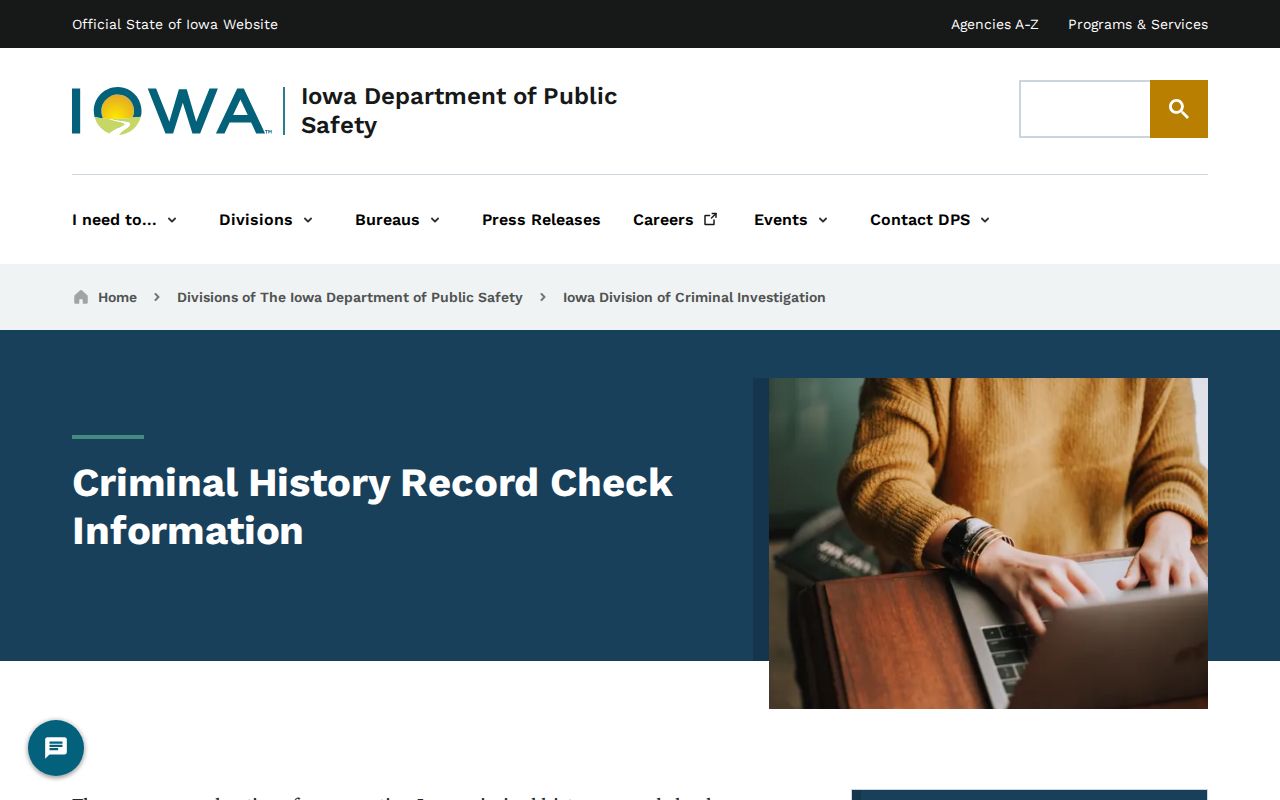
A DCI result covers releasable Iowa repository data, not a nationwide history and not merely Union County court activity. The Union County sheriff offers fingerprinting at the jail for a posted $20 fee. An individual seeking a federal Identity History Summary from Union County must use the FBI's fingerprint-based process.
| Official channel | Posted cost | Best use |
|---|---|---|
| Iowa DCI name check | $15 per last name | Releasable Iowa repository history |
| Union County fingerprinting | $20 | Local fingerprint capture; confirm card and schedule needs |
| Iowa Courts Online | Basic search free | Public case and docket information |
| Sheriff report or copy | Fee not published | Local incident or booking material |
When Union County Records Disagree
A blank Union County result does not always settle the issue. DCI says “no Iowa criminal history” can mean there is no record, no information that may be released without authorization, or confidential juvenile information. A Union County court case may exist without a DCI match if fingerprints were not sent or a disposition has not linked to the arrest cycle. A jail entry may appear before the county attorney files a case.
The reverse can also occur. A person may have a court case but no current county-jail entry because release occurred, supervision ended, or Iowa DOC took custody. A dismissed case may remain visible until a valid expungement order changes court access. Compare the arresting agency, booking date, case number, filed charge, disposition, and repository response. Those fields show whether the sources describe the same event.
- Arrest-stage charge
- The officer's allegation at the time of arrest, subject to later review.
- Filed charge
- The count the Union County Attorney brings in court.
- Disposition
- The recorded result, such as conviction, acquittal, dismissal, or another final court action.
- Repository cycle
- A fingerprint-supported arrest linked with disposition data reported to DCI.
Kinds of Criminal Records
Union County criminal records describe separate acts and stages. An incident report can exist without an arrest. An arrest report states an officer's basis for taking someone into custody. The jail then opens a booking file. If the county attorney files charges, the clerk opens or updates a court case. DCI may later connect the fingerprint-supported arrest with the court outcome.
Other channels answer narrower questions. The sheriff and courts hold warrant information, although Union County publishes no verified online active-warrant list. Iowa DOC covers people committed to state custody or supervision. The Iowa Sex Offender Registry is a distinct chapter 692A system. Juvenile records have tighter limits under state law.
Choosing the correct Union County source also affects what can be verified. Union County police files can name the report writer and describe probable cause, but they do not supply a final court result. Booking data can confirm intake or transfer, yet it may preserve the first charge label rather than the count later filed. The Union County clerk's docket is the sound source for the court outcome. DCI is the state source for releasable repository history. These records should be read as linked parts, not interchangeable reports.
- Police and sheriff reports: event narratives, agency actions, and releasable evidence details.
- Booking records: intake time, initial charges, bond, custody, and transfer facts.
- Court files: filed counts, hearings, pleas, orders, judgment, and sentence.
- DCI records: releasable Iowa arrest and disposition cycles tied to fingerprints.
- Corrections and registry records: state custody, supervision, or registration status.
Union County Jail Record Limits
The official Union County jail page does not provide a live inmate roster, booking log, or mugshot gallery. The correct lookup channel is 641-782-7717. Ask whether Union County booked the person, whether the county still has legal custody, and whether the person is housed elsewhere. This matters because the county says its 11-bed jail is generally full and may place inmates in another county.
The Iowa DOC inmate and family services page leads to the state offender search. The image below reflects that statewide route.
Iowa DOC Offender Search is for state commitments or supervision. It does not replace a call to the Union County Jail for a local pretrial booking. Jail fees shown on the county page, including daily custody and convicted booking costs, concern cost recovery for confined people. They are not prices for a public records search.
Union County Criminal Records: What They Contain
The fields depend on the source. A public court docket may show a case ID, filing date, status, parties, charges, statutes, event history, hearings, judgment, sentence, costs, and accessible documents. A jail booking may show intake, arresting agency, initial charge, bond, custody, housing, release, transfer, and a linked case number. A DCI response may show identity data, an arrest cycle, the agency, charges, and a reported outcome that state law permits DCI to release.
| Name and identifiers | Legal name, aliases when supported, birth details, and other match aids subject to release rules. |
|---|---|
| Arrest and booking | Agency, event date, intake, initial counts, bond, custody, and transfer information. |
| Charges and statutes | Offense labels and Iowa Code citations at the arrest or court stage. |
| Disposition | The court outcome and date, which may differ from the initial allegation. |
| Sentence | Custody, probation, financial terms, or other orders shown in the public file. |
| Supervision status | Publicly available Iowa DOC commitment or community-supervision information. |
Protected identifiers, juvenile information, victim details, medical data, sealed filings, and active investigative facts may be absent or redacted from a Union County record. A Union County name match alone is not enough to identify a person.
Union County Warrants Without a List
Union County has no verified public active-warrant database. For a warrant tied to your own case, call the sheriff at 641-782-7717, search Iowa Courts Online for public docket events, and contact the clerk at 641-782-7315. A case chronology may show issuance, failure to appear, recall, execution, or bond. It may not show sealed or juvenile warrants, and an update can lag.
Ask Union County staff for the case or warrant number, issuing court, and current appearance or bond direction. Legal counsel can help plan a safe response. Keep proof when a Union County warrant is recalled or satisfied, then confirm the court and law-enforcement systems updated. A broad web search cannot prove that no warrant exists.
Iowa Public Access Laws
Iowa's public-record rules start with access but do not make every criminal-history item open in full. Court access also follows Judicial Branch rules and sealing orders. A public judgment can coexist with a redacted victim address. An open docket can coexist with a withheld investigative narrative. A DCI check can disclose less without authorization than with a signed release.
Key Iowa laws:
Iowa Code chapter 22 gives the right to examine public records, allows reasonable access arrangements and fees, and identifies confidential exceptions.
Iowa Code chapter 692 governs the collection and release of criminal-history and intelligence data.
Iowa Code section 232.147 limits disclosure of juvenile records.
Iowa Code chapter 901C sets expungement routes for qualifying cases and convictions.
When a Union County sheriff record is not routinely provided, make a focused chapter 22 request. Give the record type, date range, location, incident number if known, and a preferred format. Ask for the legal basis of any Union County withholding and whether nonconfidential parts can be separated and released.
Union County Fingerprints to DCI
Fingerprints are the bridge between a Union County arrest and the DCI repository. The Union County arresting or booking agency records the event and submits fingerprint-supported data. The court later reports the disposition. Missing fingerprints, identifier mismatches, or an unlinked outcome can leave the state history incomplete even when a local report or court case exists.
For an individual's nationwide federal identity-history review, use the FBI Electronic Departmental Order portal and follow its current fingerprint instructions. The captured federal entry page appears below.
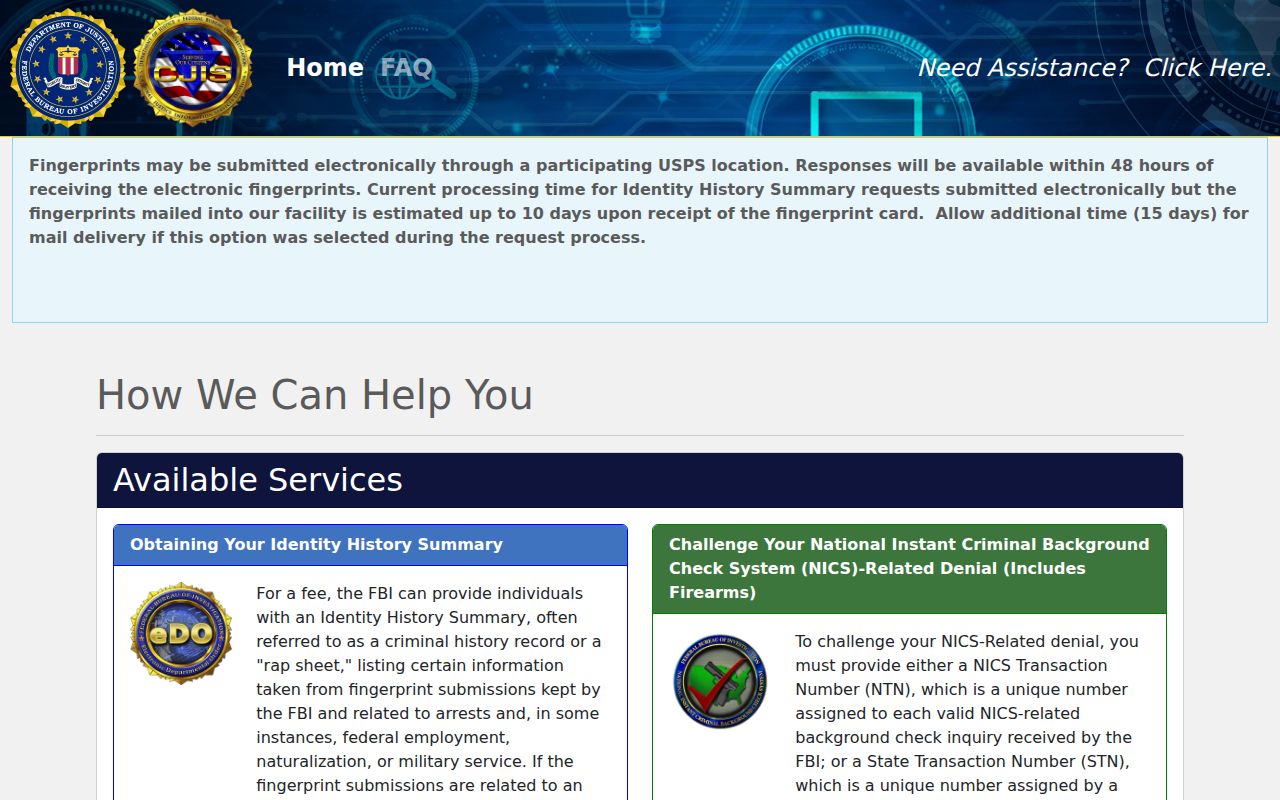
An FBI Identity History Summary is not the same product as an Iowa DCI check or a Union County docket search. Each has different coverage, identifiers, and correction paths.
Restricted, Sealed & Expunged Records
Iowa uses the term expungement. Chapter 901C covers qualifying acquittals, dismissals, and limited misdemeanor convictions. Eligibility depends on the exact charge, result, waiting period, excluded offenses, prior use, and payment of required financial obligations. Section 907.9 separately addresses eligible deferred judgments after discharge. A dismissal alone does not guarantee that every record disappears.
File the proper Judicial Branch application in the Union County case through the Union County clerk. Keep the signed order. Then check how Iowa Courts Online treats the file and obtain a later DCI check for self-review. If an eligible Union County entry remains, DCI may need the order and identity proof to correct its record. Agency reports and lawfully published material can follow different rules from the court file.
Union County Probation and Parole
Union County does not run a county probation department. Iowa DOC's Fifth Judicial District provides probation, parole, pretrial supervision, electronic monitoring, treatment, fugitive work, and other community services for Union County. The Iowa Board of Parole makes release decisions, while DOC district staff supervise people in the community.
The Fifth Judicial District page documents the district structure and services. Its captured page is shown below.
Use Iowa DOC Offender Search for Union County custody or supervision status, Iowa Courts Online for sentencing and revocation events, and the district office for a status it can lawfully confirm. Union County officer notes, treatment details, risk assessments, and personal supervision plans are not ordinary public records.
City-by-City Criminal Records in Union County
Creston, Afton, and Lorimor use different local starting points even though filed cases flow into the same Iowa court system. Creston Police creates city reports in the county seat. Afton has a one-officer police department supported by the sheriff. No separate Lorimor police portal was verified, so the sheriff is the official law-enforcement route there.
Creston Record Check
County seat records move among Creston Police, Union County Jail, and the District Court clerk.
Afton Record Check
Afton Police holds city reports, while the county handles booking and state court files.
Lorimor Record Check
The Union County Sheriff is the verified report route for this rural city.
Requesting Union County Police Records
There is no single Union County police-report pool. Contact the agency that investigated the event. Use Creston Police for its city incidents, Afton Police for Afton reports, and the Union County Sheriff for sheriff investigations and the verified Lorimor route. The jail holds booking material even when another officer made the arrest. The clerk, not the police agency, holds the filed case and judgment.
For a sheriff request, call first, then send a focused request by a confirmed route such as mail, fax, or in person. Include requester contact, the type of record, an incident or booking number when known, date and place, desired delivery format, and whether certification is needed. No general sheriff report-copy fee or records email was found in official sources, so ask about cost and secure delivery before sending sensitive identifiers.
Active investigative details, juvenile material, medical facts, victim identifiers, and security-sensitive content can require redaction or withholding. If the office cannot release the whole Union County record, ask whether it can provide a separated public portion and identify the legal basis for the rest. Production may take time for search and review. Meanwhile, a public charging document or docket entry may be available from the clerk even when the agency narrative is still restricted.
District Court Clerk
300 N. Pine St., Suite 6
Creston, IA 50801
641-782-7315
Weekdays, 8:30 a.m. to 4:30 p.m.
Union County Sheriff and Jail
302 N. Pine St.
Creston, IA 50801
641-782-7717
Call before a records visit because posted hours differ.