
Union County Sex Offender Checks
The Iowa Sex Offender Registry is the main public source for a Union County sex offender search. Iowa DPS and its Division of Criminal Investigation maintain the statewide system. A visitor can narrow results by Union County, a city, a ZIP code, a name, or a map location. The Union County Sheriff's Office is the local registration and verification agency. Its staff can explain local reporting procedures and receive a report of possible noncompliance, but the office does not replace the public statewide search with a separate county list.
Start with enough detail to avoid a false Union County match. A full name is useful, while city and county filters help when the spelling is uncertain. Read the full Union County registry profile before drawing a conclusion. The same name can belong to more than one person, and a map result may reflect the last registered data rather than real-time movement. For a person who may live or register outside Iowa, add the federal search described below.
Union County Registry Redesign
Iowa launched a redesigned public registry on August 22, 2025. The change kept the official address while adding stronger search tips, interactive maps, area counts, and clearer routes to active and most-wanted registrants. Those features make a Union County search easier to frame, but they do not turn a map into a live location tracker. Markers and counts should be read with the site's own definitions and update information.
The Iowa DPS redesign announcement shows the feature set introduced for the public. The official capture below documents what changed for a Union County search without reproducing any registrant's identity.
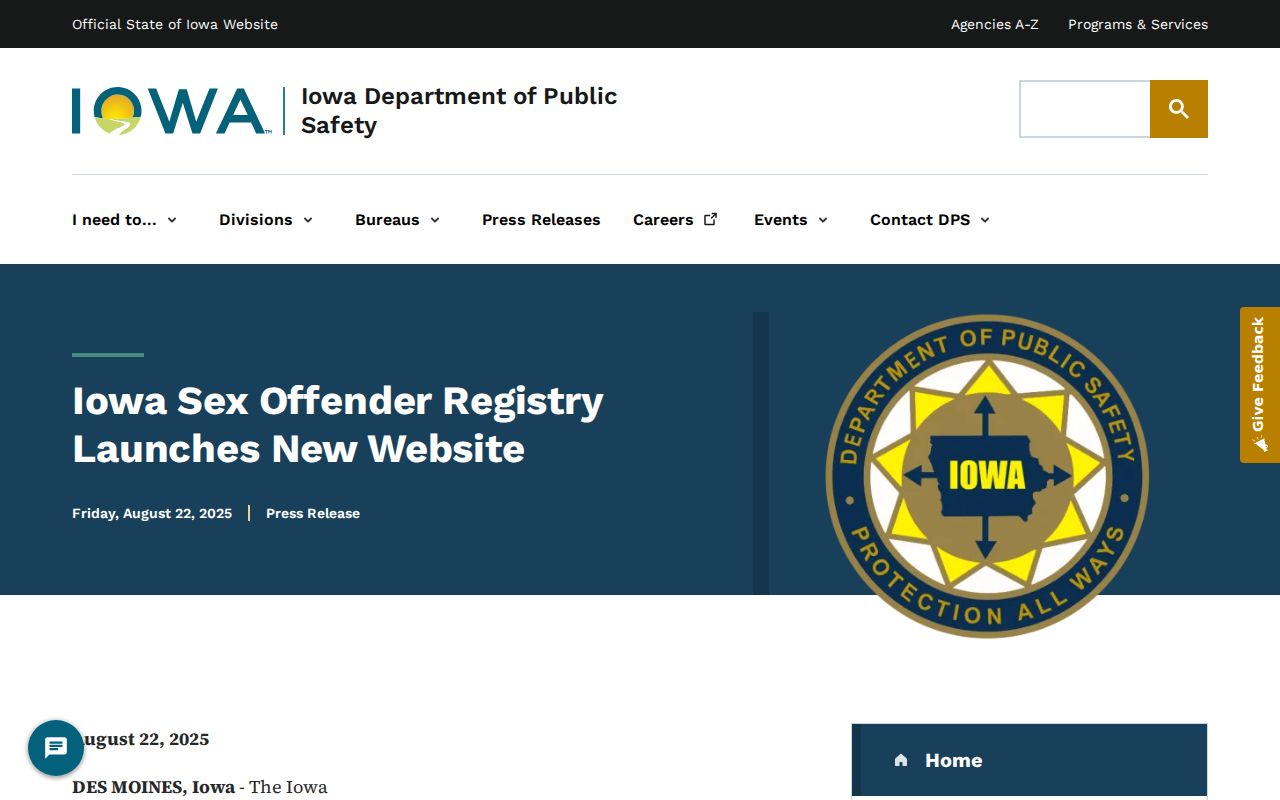
The redesign helps Union County residents move between a broad area view and the details on an individual public profile.
Iowa Sex Offender Registry Searches
The official interface supports several ways to search. A broad Union County query gives local context, while a name search is better when the person is known. Location tools can assist with Union County neighborhood awareness. No one field is mandatory in every search path, but a query must be submitted through the search control. Use aliases or spelling variations only when the interface supports them.
- Open the Iowa registry and read its current conditions, warnings, and search tips.
- Enter a name or choose Union County, Creston, Afton, Lorimor, a ZIP code, or another supported location filter.
- Review the result set and compare the photograph, physical description, aliases, and location details before selecting a profile.
- Open the full record and read the offense basis, tier, status, and verification information instead of relying on the list or map alone.
| Field or control | Type | Required | Use |
|---|---|---|---|
| Name | Text | Optional | First and last name; try supported aliases or spelling variants |
| County | Dropdown | Optional | Select Union for a county-focused result |
| City | Text or dropdown | Optional | Narrow to Creston, Afton, Lorimor, or another locality |
| ZIP code | Text | Optional | Uses a five-digit geographic filter |
| Address or map | Location tool | Optional | Supports geographic or proximity review where enabled |
| Active or most wanted | Navigation | Optional | Opens the highlighted public lists |
The official Iowa registry search is the source for the interface shown below. Its controls can change, so users should follow the labels displayed during the current session.
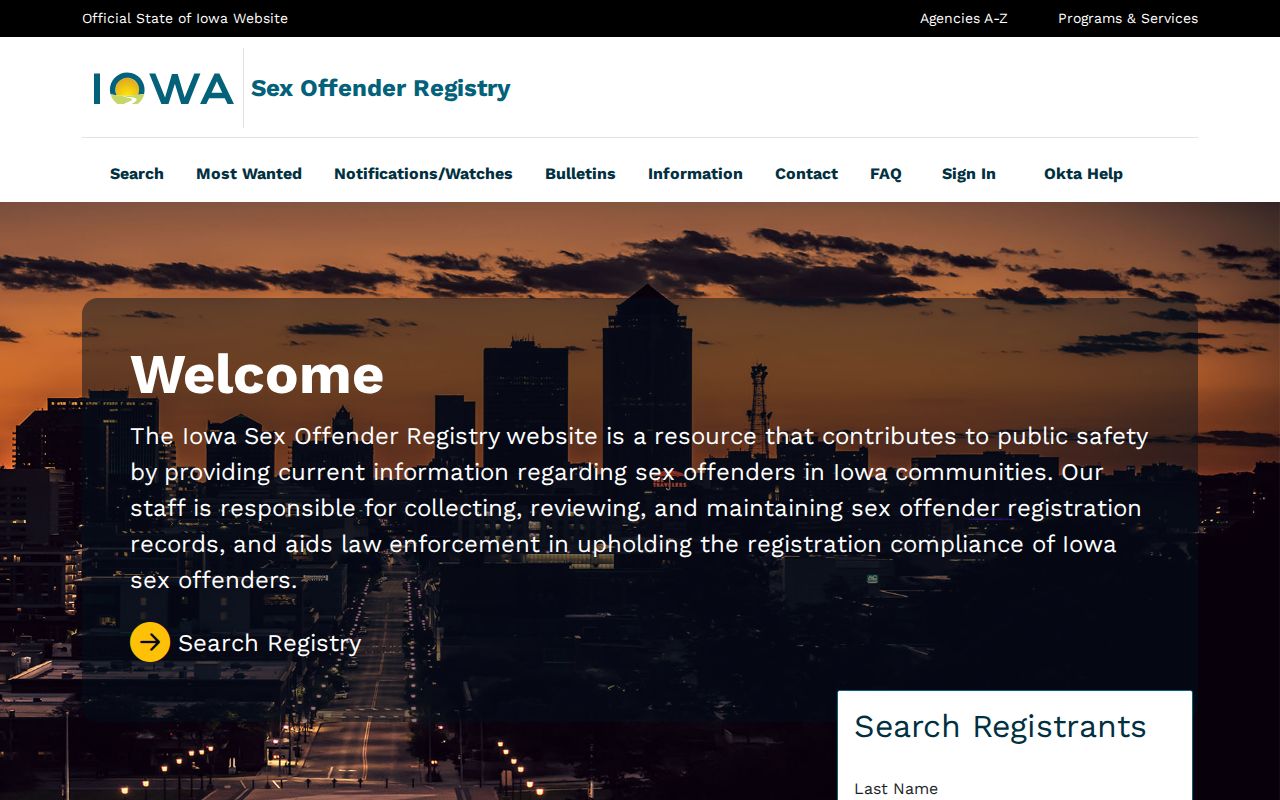
This view is the proper starting point for public Union County registry records, not a commercial people-search page.
Union County Map Limits
A Union County registry pin is a search aid. It is not proof that a person is at the marked spot now, and it does not measure risk. Address information can lag a move or a report that is still being processed. The better approach is to open the associated Union County profile, check the registration status and verification data, and compare the location details with the registry's definitions. Do not use a crowd-sourced map to replace the state record.
If Union County address information appears stale, preserve the profile link or search details and contact registry staff. The sheriff's official facility page confirms the local office at 302 N. Pine Street in Creston. Call 641-782-7717 to ask about the proper reporting channel. DCI registry staff can also be reached at 515-725-6050 or sorinfo@dps.state.ia.us. Report a concern; do not confront the person shown.
Note: A map marker reflects registry data and should never be treated as real-time surveillance or proof of a new offense.
Registry Profiles: What They Show
Iowa Code chapter 692A authorizes public registry fields. The exact display depends on the record and the current interface. A Union County profile may combine identity aids, the registration offense, status, and location facts. It can also show indicators tied to residence or exclusion-zone rules. The record describes a legal registration duty based on a qualifying offense. It does not establish that a new crime has occurred.
| Name and aliases | Public identifying names used to distinguish records and search spelling variants |
|---|---|
| Photo and description | Photograph and physical details, which may include scars, marks, or tattoos |
| Residence information | Public location details allowed by chapter 692A and current registry rules |
| Offense and statute | Registration offense, statutory citation or text, and related conviction details when displayed |
| Tier and restrictions | Offense-based tier plus public indicators for relevant residency or exclusion-zone limits |
| Status and verification | Registration or compliance status, duration information, and last-verification data where shown |
Match several fields before deciding that a Union County result concerns the intended person. Names alone are weak identifiers. A photo, alias, physical description, offense jurisdiction, and current status provide a sounder basis for understanding the Union County public record.
Union County and NSOPW
The Iowa registry is the right first layer for a Union County search. The National Sex Offender Public Website, maintained as a U.S. Department of Justice service, adds participating jurisdictions beyond Iowa. It is useful when a name may connect to another state or when a family safety check crosses state lines. NSOPW directs searchers to the public records supplied by participating registry systems rather than creating a new local Union County file.
The national search source is pictured below. It should be used as a second official channel, not as a substitute for reading Iowa's current profile terms or calling Union County registry staff.
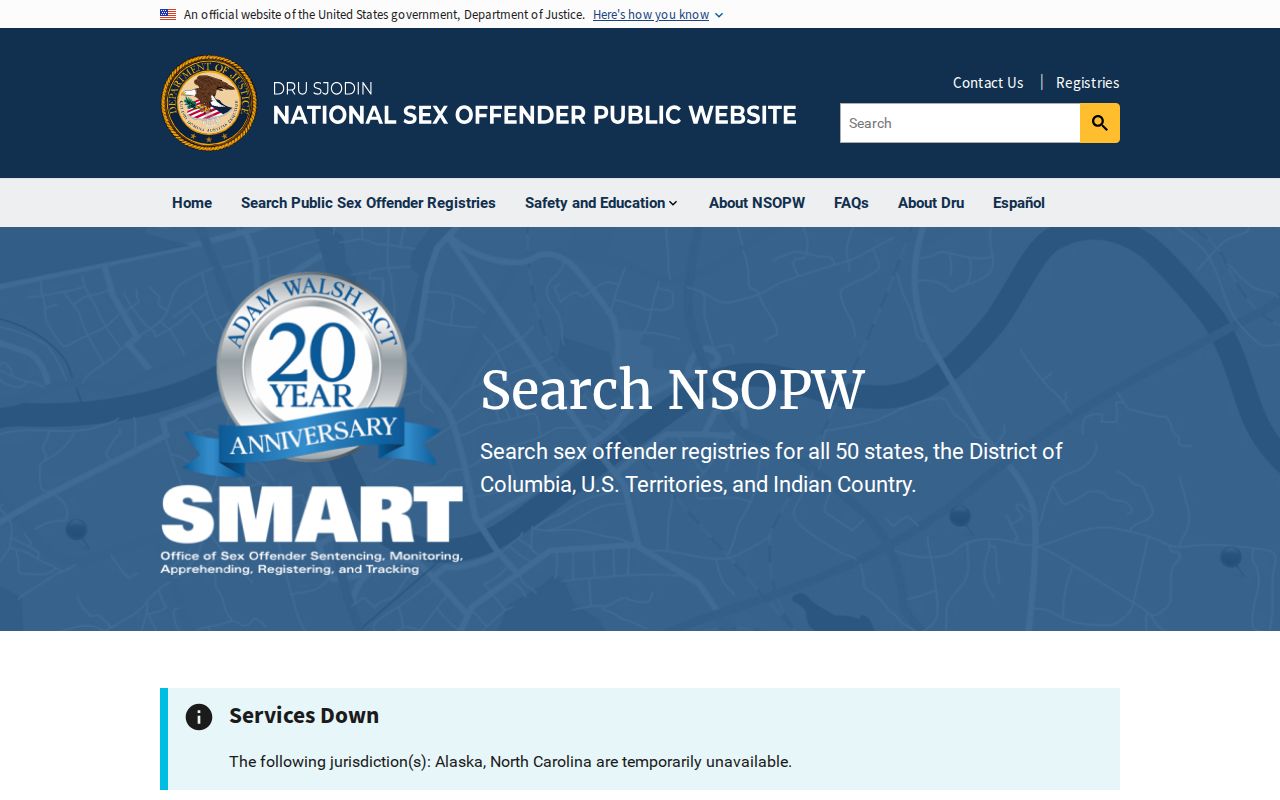
Comparing the two official systems helps when a Union County search involves a move, an out-of-state conviction, or records held by different jurisdictions.
Registration Levels and Duties in Iowa
Iowa's three tiers set how often a person verifies information in person. Tier does not, by itself, state how long registration lasts. That distinction is crucial in a Union County registry review. Iowa Code §692A.102 addresses classification, while §692A.106 controls ten-year and lifetime duration categories along with tolling and extension rules. Section 692A.104 addresses where and when registration occurs.
| Tier | Duration rule | Verification frequency |
|---|---|---|
| Tier I | Consult §692A.106; tier alone does not set duration | Annually |
| Tier II | Ten-year or lifetime rules and tolling depend on the statute | Every six months |
| Tier III | Duration remains statute-based, not a generic tier label | Every three months |
A person seeking a change to a Union County registration duty cannot infer eligibility from the public tier alone. Iowa Code §692A.128 creates a judicial modification route with strict conditions. Questions about a specific order or deadline belong with qualified counsel, the court, or Union County registry officials.
Union County Registration Office
The Union County Sheriff's Office is the local point for registration and verification. The county government directory routes readers to the sheriff, whose office and jail share 302 N. Pine Street, Creston, IA 50801. Registrants should call 641-782-7717 to confirm an appointment, documents, and the process for reporting a change. These tasks are different from a public web search. The sheriff verifies and enforces local duties; DCI maintains the statewide system.
Union County Sheriff's Office
302 N. Pine St.
Creston, IA 50801
641-782-7717
Call for registration appointments, required documents, reporting changes, or possible noncompliance.
Iowa DCI Registry
215 E. 7th St.
Des Moines, Iowa
515-725-6050
Email sorinfo@dps.state.ia.us for statewide registry questions.
For an immediate Union County safety emergency, use emergency services. A delayed update, disputed location, or compliance concern should go through the ordinary Union County sheriff or DCI registry channel so trained staff can assess it.
Union County Residency Indicators
Some Union County public profiles include indicators tied to Iowa residence limits or exclusion zones. Iowa Code §§692A.111 through 692A.114 cover public access, exclusion zones, and residency restrictions. Those rules are more exact than a rough distance drawn by a user on a Union County map. A location marker does not tell the whole legal story, and a profile can involve facts or exceptions not apparent from a general area view.
Use the displayed indicator and statutory citation as the starting point. Then contact Union County registry staff if a local compliance question remains. The sheriff has the enforcement role and current registration history. Neighbors should not investigate, follow, photograph, or confront a registrant. That conduct can create risk and may interfere with official work.
Using Registry Information Lawfully
Union County registry information supports personal, family, and community safety planning. Read the profile, keep the limits of the Union County data in view, and use official contacts for questions. Active and most-wanted links have specific meanings on the Iowa system. A profile's presence is not permission to spread unverified claims, and a registration record is not proof of current misconduct.
Use registry data lawfully: Iowa Code chapter 692A and the registry warning prohibit harassment, threats, intimidation, and criminal misuse. Misuse can be a crime or create civil liability. Report suspected noncompliance to law enforcement and never confront the person.
The safest multi-channel sequence is simple: search Iowa's registry, read the complete profile, use NSOPW if another state may matter, and call Union County staff about local procedure or apparent noncompliance. Each step preserves the difference between public awareness and law enforcement.